
Timeouts: the most important number in distributed systems (and the easiest one to get wrong)
Systems Literacy


It’s 2 a.m. and the pager goes off. Not the clean kind of alert where a service is down and you know what to restart - the kind where the dashboard is a wall of yellow and nobody can quite say what’s wrong.
The graphs disagree with each other. Error rate is creeping up. Latency is climbing. But CPU is fine. Memory is fine. Nothing is crash-looping. Nothing is “down”.
And yet the system feels… stuck.
One downstream service is “healthy” according to the health check, but it’s slow - just slow enough to turn every upstream caller into a waiting room. Retries begin to pile up like cars entering a tunnel that’s partially blocked. The tunnel isn’t closed. Traffic still moves. But the throughput has dropped, and now the entrance ramp is backing up onto the highway.
The most unsettling part is that nobody deployed code today.
So why does the system suddenly feel frozen but not dead?
There’s a particular kind of failure that doesn’t look like failure at first. Things don’t crash. They don’t spike CPU. They don’t throw dramatic exceptions. They just take longer. And in distributed systems, “taking longer” is not a neutral state. Sometimes waiting longer helps and the system recovers. Sometimes waiting longer turns a manageable slowdown into a cascading outage.
If you’ve felt that contradiction - waiting longer sometimes fixes it, and sometimes breaks it - you’re already standing at the doorstep of timeouts.
⏱️ Everyone who’s been on call for a “nothing is down but it’s unusable” incident knows this feeling — send it to whoever’s carrying the pager next.
Waiting is not free
In a single-process application, “waiting” often feels harmless. A function blocks, eventually returns, and the program continues. Even if it’s slow, the slowness is contained inside one runtime with one set of resources. You can profile it, optimize it, or scale the machine vertically.
But a distributed system doesn’t “call a function”. It asks another machine - over a network - to do work. And that work often asks another machine to do work. And so on.
So a single user request that looks like a simple action - tap Pay - is usually a chain:
Client → API → Auth → DB → Cache → Payments → Notifications
You may not have all of those hops in your system, but you almost certainly have some chain. As systems grow, chains get longer for reasons that are usually rational at the local level: separation of concerns, independent scaling, organizational boundaries, regulatory boundaries, data boundaries. The chain is how you keep each part manageable.
But the chain forces you to answer questions that are easy to avoid in a monolith:
Is the dependency slow, or is it broken?
Should we keep waiting, or should we stop and try something else?
If we stop waiting, what does “try something else” even mean for this operation?
The naive strategies that feel fine early on start to fall apart as soon as load and concurrency enter the picture.
Indefinite waiting is the simplest choice conceptually: “I’ll just wait until I get an answer”. That choice feels polite. Patient. It’s also one of the fastest ways to quietly exhaust your system.
When a service waits, it holds onto something: a thread, an event-loop slot, a connection, memory for request context, entries in a queue, file descriptors, locks, or a place in a connection pool. Different architectures hold different resources, but none of them are free at scale.
And distributed systems fail in ways that aren’t clean. Partial failures are normal. One dependency can be slow while everything else is fine. One availability zone can be impaired. One database replica can be lagging. One specific shard can be hot. Nothing is “down”, but something is degraded.
This is where concurrency amplifies pain. Ten slow requests don’t stay as ten slow requests. Under traffic spikes, they turn into hundreds or thousands of callers all waiting at once. And as more callers wait, you consume more resources, which reduces your ability to serve other requests, which increases latency, which creates more waiting. The feedback loop is ugly because it’s subtle: everything is “working”, just increasingly poorly.
There’s also a deeper reality that makes this problem fundamentally hard - you often cannot tell the difference between:
“This request will succeed in 2 seconds”, and
“This request will never succeed”.
From the caller’s perspective, the network doesn’t provide truth. It provides uncertainty.
Packets get delayed. Queues build up. A server can accept a connection but be too overloaded to respond quickly. A request can be processed but the response can be dropped. A load balancer can route you to a sick instance. Your own process can pause for GC at the wrong time.
If your system’s plan is “wait until you know for sure”, then your plan is to wait forever - because “for sure” is rarely available.
So the core problem is not just that slow things are annoying. The core problem is that waiting is an implicit commitment of resources under uncertainty, and at scale that commitment becomes one of the main determinants of whether your system stays stable.
A timeout is a decision, not a knob
A timeout is often described like a knob you turn to make things “faster”. That framing is tempting, but it’s misleading in a way that causes real incidents.
A timeout does not make a slow dependency fast.
A timeout is a decision that says:
“I am willing to wait up to *this* long for this work to complete. After that, I will behave as though it failed, and I will take a different path”.
That “different path” is the whole point. Without a next move, a timeout is just an error generator. With a next move, a timeout becomes a tool for keeping the rest of the system alive.
In plain language, timeouts protect three things that tend to be invisible until an outage:
Your system’s ability to keep serving other work.
When you bound waiting, you bound how long you tie up resources. That makes your service less likely to get “stuck” as load increases.
User experience.
Users handle fast failure better than slow ambiguity. A quick “we couldn’t do that” (with a clear next step) is often less damaging than a spinner that makes them wonder whether the app is broken, whether they should retry, or whether something partially happened.
Overall stability.
Unbounded waiting creates piles: piles of threads, piles of requests, piles of retries, piles of open connections. Timeouts cap pile size and make overload behavior more predictable.
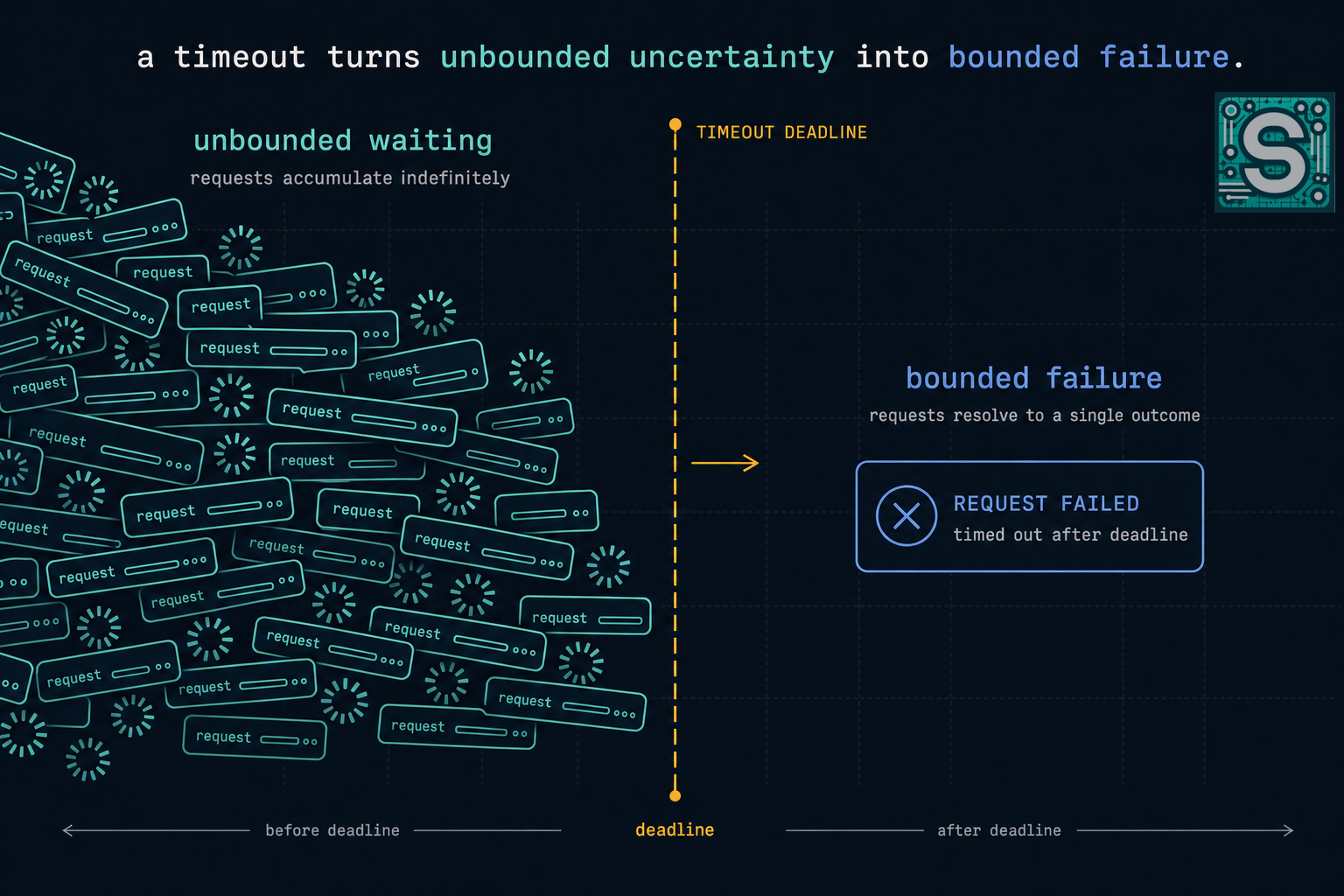
The key mental shift is this: timeouts turn unbounded uncertainty into bounded failure.
Not “no failure”. Bounded failure. Predictable failure. Failure that you can plan around.
And if there is one theme that repeats across mature distributed systems, it’s that reliability is less about eliminating failure and more about choosing how failure behaves under stress.
Spending a time budget
Budgeted waiting
A useful way to think about timeouts is not as isolated numbers sprinkled throughout code, but as a time budget that gets spent as a request flows through the system.
Step 1: A request begins with a time budget (explicit or implicit). Sometimes this budget is literally configured (“this endpoint must respond within 2 seconds”). Sometimes it’s implicit in user expectations (“a checkout page that takes 12 seconds is basically broken”). Either way, the request has a patience limit.
Step 2: Each hop spends part of that budget. The API gateway spends some time parsing, authenticating, routing. A service spends time doing business logic and calling dependencies. The database spends time executing a query. None of these steps knows in advance how long it will take, but each one consumes time from the same overall budget.
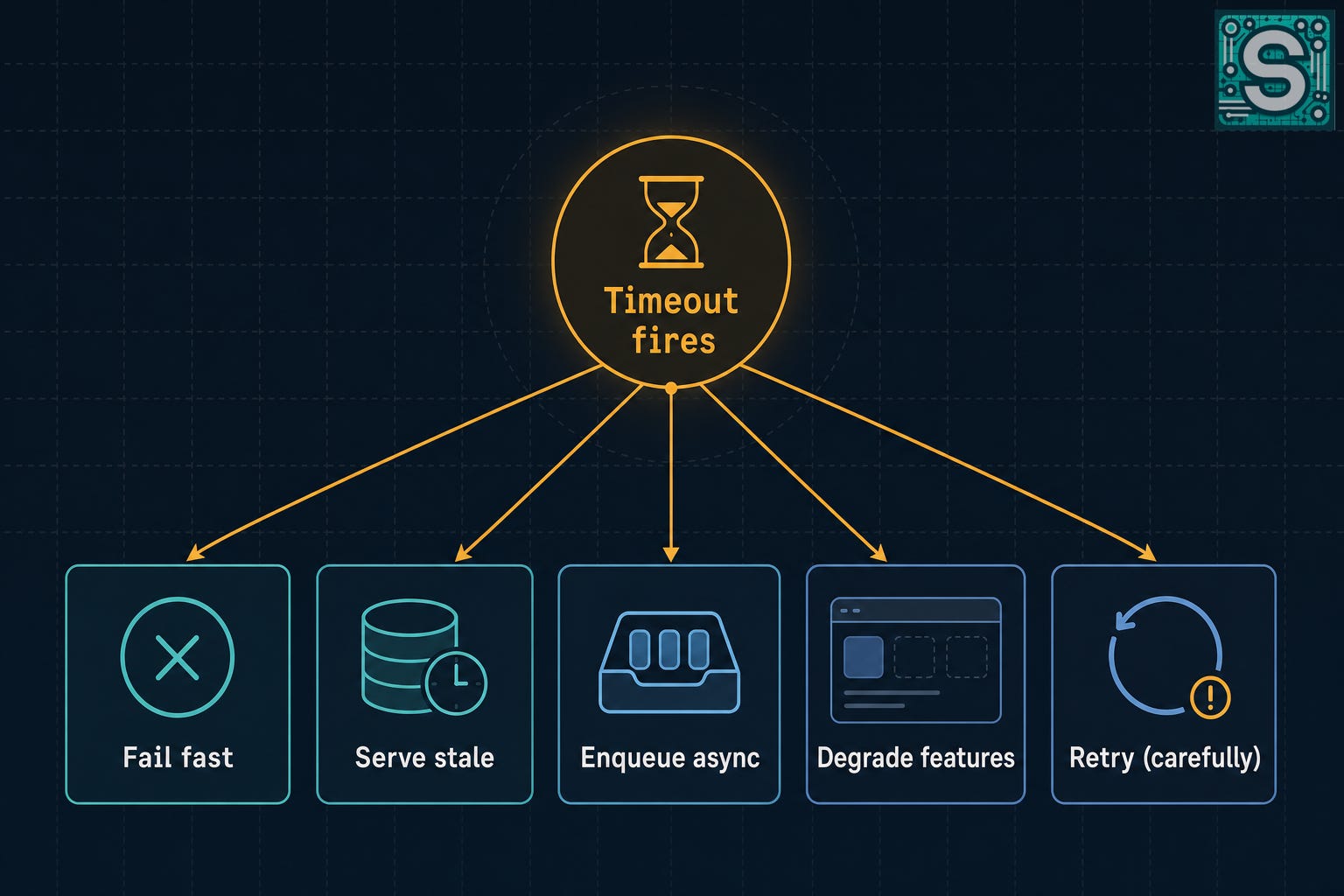
Step 3: If time is exceeded at any point, the caller stops waiting and chooses a response path. This is where timeouts stop being “numbers” and become “policies”. The system decides: do we fail fast, degrade gracefully, serve stale data, enqueue work, or retry?
A request chain with deadlines
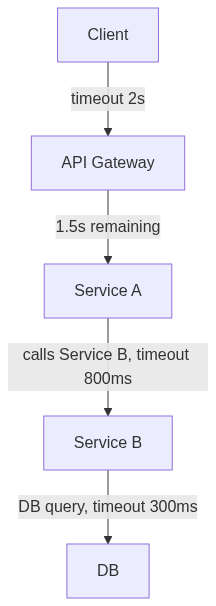
The diagram is simple, but it captures something important: timeouts are not only per-service choices. They’re a choreography.
There are two ideas here that are worth naming because they prevent a lot of accidental chaos.
First is the local timeout: each component decides how long it will wait for its direct dependency. Service A decides how long it will wait for Service B. Service B decides how long it will wait for the DB.
Local timeouts are unavoidable. Even if you carry an end-to-end deadline, each hop still needs to translate that into its own concrete waiting behavior, because each hop owns its own resources.
Second is the end-to-end deadline: the original request carries a “must be done by” time that flows downstream. This is usually the healthier mental model, because it aligns the whole chain around a shared constraint instead of letting each hop “pick a number that feels good”.
I like the meeting analogy for deadlines: imagine a meeting that ends at 10:00 no matter what. If it’s 9:55, you don’t start a new complex topic. You summarize, assign follow-ups, and move on. The end time changes what is rational to attempt.
Deadlines do the same thing to services. If a service sees that there are only 200ms left, it may choose a cheaper query, skip optional dependencies, or return partial data. The goal isn’t perfection; it’s finishing something coherent within the remaining budget.
What happens on timeout
When a timeout happens, the system needs a plan. Common plans include:
Return an error quickly (fail fast).
Sometimes this is the least bad option, especially for operations where partial success is dangerous.
Use cached or stale data.
You trade freshness for availability, which is often the right call for read-heavy user experiences.
Enqueue work for later (async).
Especially useful when the user doesn’t need the final result immediately, or when you can acknowledge the request and complete it out of band.
Degrade features.
If recommendations are slow, render the page without them. If analytics logging is slow, skip it. If a profile enrichment call is slow, return the core profile.
Trigger retry logic (carefully).
Retries are not inherently bad, but they are one of the easiest ways to turn a slowdown into a storm. The “carefully” is doing a lot of work there, and we’ll come back to it.
The important point is that a timeout is only half of the design. The other half is the fallback behavior you choose - and what that fallback implies for correctness, user trust, and downstream load.
What bounding the wait costs you
Timeouts have a reputation for being “just configuration”. In practice they are one of the most consequential policy choices you make, because they reshape how your system behaves under stress.
What timeouts improve
Timeouts are one of the few tools that directly control tail latency. Average latency might look fine while your p99 quietly becomes intolerable. The long tail is where user sessions die and where incident tickets get created.
By bounding waiting, you stop the “slowest 1%” from expanding indefinitely and dominating your system’s capacity. This matters because queues form from the tail, not from the median. A small fraction of very slow requests can hold onto a disproportionate amount of resources.
Timeouts also provide resource protection. When threads don’t wait forever, your thread pool is less likely to be exhausted. When connections aren’t held indefinitely, your connection pools recover faster. When request contexts don’t accumulate, your memory pressure drops.
Another underrated benefit is faster detection of bad downstream behavior. In a distributed system, “healthy but slow” is often equivalent to unhealthy. If a dependency is responding slowly enough to cause upstream pileups, then from the caller’s perspective it is not fulfilling its contract. Timeouts make that reality visible.
And finally, timeouts help with blast-radius containment. Without them, one slow dependency can freeze many upstream services. With them, upstream services can cut their losses, degrade, and continue serving some fraction of traffic.
What timeouts make worse
Timeouts also make some problems more visible, and visibility can feel like regression.
A timeout converts “eventual success” into “declared failure”. That means you will often see more errors in dashboards, even as user experience improves overall. The system becomes more honest about what it can’t do within the required time.
Timeouts also increase inconsistency risk. A caller can time out and give up, while the callee continues processing and eventually succeeds. That’s not a theoretical edge case; it happens constantly in real systems. If the operation has side effects (charging a card, reserving inventory, sending an email), then “caller gave up” does not mean “nothing happened”.
This is the classic double-charge: the first attempt may have succeeded late, but the client timed out and retried, causing the side effect to happen twice. The timeout didn’t cause the bug alone; it revealed the system’s lack of a safe strategy for duplicate requests.
Timeouts can also create higher retry pressure when retries are naive. If every timeout triggers an immediate retry, you’re effectively multiplying load precisely when the system is already struggling. This can turn a mild slowdown into a self-sustaining overload loop.
New risks introduced by timeouts
Once you start bounding waiting, you introduce new failure modes that are less obvious than “it’s slow”.
One is the retry storm (or thundering herd): many clients time out around the same time and retry together, spiking traffic in synchronized waves. Systems often fail not because they can’t handle steady load, but because they can’t handle synchronized bursts created by uniform retry behavior.
Another is duplicate work. Even if duplicate side effects are prevented, duplicate computation can still be expensive. If a slow request is still being processed and you retry, you may now have two expensive operations running for one user action.
And there’s the “split-brain” user experience: the user sees failure, but the side effect happened. That is often the most trust-damaging outcome because it breaks the user’s mental model. If the UI says “payment failed”, users assume no money moved. If the system later contradicts that, it feels like betrayal - even if the backend is technically consistent.
The trade-offs you can't escape
Timeout decisions force trade-offs you can’t escape; you can only choose where you sit.
Latency vs correctness: Short timeouts make the system feel responsive, but they increase the chance that you cut off valid work. If your downstream normally completes in 400ms but occasionally takes 900ms, a 500ms timeout will convert that occasional variance into user-visible failures. Sometimes that’s acceptable; sometimes it’s not.
Availability vs correctness: Serving cached or stale data keeps the system available, but it may be wrong. Whether that’s acceptable depends on the feature. Showing a slightly stale feed is fine; showing a stale account balance might not be.
Simplicity vs scalability: “Just wait longer” is conceptually simple and can even feel safer. The problem is that its cost grows with concurrency. At small scale you can afford to be patient. At large scale, patience can be what kills you.
Local optimization vs end-to-end behavior: If each service chooses timeouts independently, the chain becomes chaotic. One service might wait 2 seconds, while its dependency gives up after 200ms. That mismatch produces wasted work, confusing logs, and unpredictable user experience. End-to-end time budgeting tends to reduce this chaos by aligning the system’s patience.
Timeouts, component by component
Timeouts show up in different forms across a system. The underlying idea is the same - bounded patience - but the symptoms and failure modes vary by component.
Databases
Databases are often where “the system is frozen but not dead” first becomes visible.
A database can be up, accepting connections, and returning some queries quickly - while a subset of queries run long, hold locks, or monopolize resources. Without query timeouts, slow queries can sit on connections for a long time. Under load, that behavior starves the connection pool, and suddenly even fast queries can’t get a connection.
Transaction timeouts play a related role. Long-running transactions can hold locks longer than intended, blocking other operations that would otherwise be quick. The result is a system that looks healthy at the machine level - CPU is fine - while user requests pile up waiting for locks.
This is one reason database incidents can feel so confusing: nothing is “burning”, but everything is waiting.
Timeouts don’t fix bad queries or poor indexing, but they prevent those problems from turning into system-wide paralysis by limiting how long any single request is allowed to monopolize shared database resources.
APIs / service-to-service calls
In service-to-service calls, timeouts define how long one service is willing to be blocked waiting on another. This sounds straightforward, but it interacts with load in a way that surprises people.
If Service A has 200 worker threads and it calls Service B, then long timeouts mean threads in A can be tied up doing nothing but waiting. Under burst traffic, you can exhaust A’s threads even if A’s own CPU usage is low, simply because A is acting like a waiting room for B.
And when A times out, it often returns an error upstream - but B may still be processing the request. That means the system can do real work that the user never sees, which is a hidden cost. It also means side effects can occur after the user believes the operation failed.
This is one of the reasons timeouts and idempotency are so tightly linked in practice: timeouts make it normal for callers to not know what happened downstream.
Queues and async systems
Async systems have their own timeout-shaped problems.
Workers can crash mid-job. They can hang. They can be paused. They can get stuck on a slow dependency. If a job is “checked out” by a worker and there’s no mechanism to reclaim it, you can end up with jobs that are effectively lost - neither completed nor retried.
This is where concepts like processing deadlines and visibility timeouts come in. The system says: “A worker has this long to finish. If it doesn’t, we’ll assume the job is stuck and make it available again”.
That assumption can cause duplicate processing, so it pushes you toward idempotent job handlers. But the alternative - jobs that vanish into limbo - is often worse.
Timeouts in async systems are a way of turning “maybe the worker will come back” into a concrete policy decision: after some time, we stop waiting and we try again.
Caches
Caches introduce a different flavor of timeout decision: do you wait for the origin?
If a cache miss triggers a call to an origin service or database, then slow origin responses can cause cache clients to pile up waiting - especially if many requests miss at once (for example, after a cache eviction or a hot key expiration).
Timeouts shape whether you:
wait for the origin,
serve stale data,
or fail the request.
In many real systems, preventing cache stampedes is a combination of bounded waiting plus techniques like jitter and serve-stale behavior. The details vary, but the intuition is stable: you don’t want a brief origin slowdown to turn into thousands of synchronized cache-miss callers all waiting (and then retrying).
Microservices and UI aggregation endpoints
Aggregation endpoints - services that compose responses from multiple downstream dependencies - are where time budgeting becomes very tangible.
If you’re building a page that needs profile info, notifications, recommendations, and experiments, you quickly discover that the user doesn’t value all of those equally. Recommendations arriving 400ms late are often worse than no recommendations at all, because they block the whole page render.
So aggregators often use explicit per-dependency budgets: “If recommendations don’t arrive in 100ms, render without them”. That is a timeout decision, but it’s also a product decision: completeness is less important than responsiveness for that component.
Aggregation is also where mismatched timeouts become painful. If the aggregator times out at 100ms but downstream keeps working for 2 seconds, you’ve created hidden load that users don’t benefit from. Good end-to-end deadline propagation helps downstream services avoid doing expensive work that cannot possibly make it back to the user in time.
Too patient, too aggressive, or absent
Timeouts fail in two directions: too much patience and too little. And the absence of a timeout is not neutral - it’s just “infinite patience”, which is usually the worst of both worlds.
Typical mistakes
No timeouts at all. This is the easiest mistake to make early on because things “work” until they don’t. Without timeouts, partial failures turn into silent resource exhaustion. Requests accumulate. Thread pools saturate. Connection pools drain. Eventually everything backs up behind the slowest dependency, and the incident looks like a system-wide stall rather than a crisp failure.
Timeouts set too high (“be safe”). This is a very human instinct: if timeouts cause errors, then longer timeouts should reduce errors. Locally, that can be true. System-wide, it often increases blast radius. Long timeouts turn every upstream service into a buffer for downstream slowness. You might reduce error rates while increasing the chance of a total stall.
Timeouts set too low (“be fast”). At the other extreme, aggressive timeouts can create self-inflicted outages. Normal latency variance starts to look like failure. Downstream services might be healthy, but they’re denied the time they need during ordinary load fluctuations. This can create a feedback loop where timeouts trigger retries, retries increase load, load increases latency, and latency triggers more timeouts.
Retries without coordination. Timeouts plus immediate retries are a classic outage recipe. If the system is slow because it’s overloaded, retrying increases overload. If it’s slow because a dependency is degraded, retrying creates more work for the degraded component. Retries can be valuable, but only when they are rate-limited, jittered, bounded, and paired with a clear understanding of what failures they are meant to address.
Mismatched timeouts in a chain. If an upstream waits 2 seconds but a downstream times out at 200ms, you can end up with wasted work and confusing traces: the upstream says “I waited forever”, the downstream says “I gave up quickly”, and neither is wrong from its own perspective. What’s missing is an end-to-end budget that aligns expectations across the chain.
No idempotency strategy for operations that may partially succeed. Timeouts make “unknown outcome” normal. If you don’t have a way to safely handle duplicate requests, you end up with the user-facing split-brain: “it failed” plus “side effect happened”. Payment flows are the obvious example, but the pattern appears everywhere: sending messages, creating orders, updating profiles, issuing refunds, provisioning resources.
User/operator symptoms
From the user’s perspective, timeout problems often look like:
spinners that end in “try again”,
repeated attempts that sometimes work and sometimes don’t,
duplicate actions (double charges, duplicate orders),
inconsistent state across screens (“order not found” then “order shipped”).
From the operator’s perspective, timeout problems often show up as:
high p99 latency and timeouts while averages look okay,
saturated connection pools,
thread exhaustion or request queue growth,
retry spikes,
“nothing is down, but it’s unusable” incidents.
That last one is worth lingering on. The most expensive incidents aren’t always the dramatic crashes. They’re the gray failures: the system technically responds, but slowly enough that users abandon it, and slowly enough that internal retries and backlogs quietly amplify the damage.
Timeouts are one of the main ways you prevent gray failures from spreading.
Systems of bounded patience
If you only remember one thing about timeouts, I’d want it to be this: in distributed systems, you rarely get certainty. You get time-based decisions.
A timeout is less a number and more a statement of values:
When things get slow, what do we value most - speed, accuracy, completeness, safety?
Which user experiences should degrade gracefully, and which should fail hard?
Which dependencies are essential, and which are “nice to have”?
How much hidden work are we willing to do that might not benefit the user?
💬 What timeout value have you most regretted setting — too patient or too aggressive? Tell me what it broke.
These are policy questions, not just engineering questions. They shape reliability because reliability is not the absence of failure; it’s the system’s ability to keep delivering something meaningful under stress.
Coordination is expensive in distributed systems. The more components you need to agree, the more likely you are to hit time limits. That’s not because engineers are bad at their jobs; it’s because each component adds variability: network hops, queues, load balancers, retries, GC pauses, lock contention, noisy neighbors.
Timeouts are one of the few tools we have to keep that variability from consuming the entire system.
There’s also an organizational analogy that I think is more than cute - it’s instructive.
A team that never sets deadlines can appear calm. Work can expand to fill the available time. Long tasks can block other tasks indefinitely. Nobody is forced to make trade-offs. It feels polite.
Then a crisis hits: a customer needs an answer, a security issue needs a patch, a launch date arrives. Suddenly the lack of deadlines reveals itself as fragility. Everything is blocked by one long-running effort.
Deadlines don’t guarantee quality, but they prevent one task from consuming all attention forever.
Timeouts are deadlines for machines. They don’t guarantee correctness, but they prevent one slow dependency from consuming all of your system’s ability to respond.
And that’s the reflective takeaway: reliability isn’t only about preventing failure. It’s about choosing how to fail so the rest of the system can keep living.
Choosing how to fail
Timeouts are how distributed systems turn uncertainty into a decision. The network will not tell you whether a request is “slow but fine” or “never coming back”. It will simply make you wait. If your system has no explicit policy for when to stop waiting, it will eventually pay for that patience with resources it can’t replenish fast enough under load.
Waiting is not a neutral choice. It has a cost in threads, connections, memory, queue space, and user attention. Without timeouts, partial failures spread outward until they become system-wide stalls. With timeouts, you trade “maybe success later” for “bounded failure now”, and that trade is often what keeps the rest of the system responsive.
But timeouts are not a free win. Bad timeout values and uncoordinated retries can create their own outages: retry storms, duplicate work, and user experiences where an operation “failed” and “happened” at the same time. The most stable systems treat timeouts as part of an end-to-end time budget, not as isolated numbers chosen independently by each service.
And once you accept time budgeting as the core model, the real design work becomes clearer: the timeout itself is only the stopping rule. The hard part is choosing what you do next - fail fast, degrade, serve stale, or shift work to async - while being honest about the trade-offs in correctness, availability, and user trust.
If you want to follow this post with the natural next chapter, the companion topic is retries. Timeouts define when we stop waiting; retries define how we reattempt without turning “slow” into “down”. That pairing is where a lot of real-world reliability stories are written - for better or worse.
📬 This is System Design Fundamentals — one primitive at a time, no hype. Subscribe and the next chapter lands in your inbox.
References
The Fallacies of Distributed Computing by L. Peter Deutsch et al. | Wikipedia
Latency Numbers Every Programmer Should Know by Colin Scott | interactive, after Jeff Dean's numbers
On Designing and Deploying Internet-Scale Services by James Hamilton | USENIX LISA '07
Designing Data-Intensive Applications by Martin Kleppmann | O'Reilly
Release It! by Michael Nygard | Pragmatic Bookshelf
Designing Distributed Systems by Brendan Burns | O'Reilly