
Idempotency: why your Payment API must survive double-clicks and timeouts
Systems Literacy


Picture someone buying concert tickets on a phone while walking out of a subway station. The signal flips between “fine” and “barely there”. They tap Pay, the UI shows a spinner, the app hesitates, and then - nothing. No error. No confirmation. Just that quiet, anxious pause where you can’t tell whether the app is thinking or dead.
So they do what any reasonable human does: they tap again. Maybe twice. Maybe they force-close and reopen. Maybe they go back and try the whole flow one more time because the page looks “stuck”.
Later that night they check their bank app and see two charges. Or they get two order confirmation emails with two different order numbers. Or support tells them, “We see two orders; we can refund one”, which is not the kind of sentence that builds trust in a checkout flow.
If you’ve ever been on-call for a system that handles money, you know what happens next. Support tickets surge. Someone starts pulling logs. Someone else starts running queries to find “duplicates”. You get a Slack thread full of screenshots of the payment processor dashboard. And in the middle of it all is the maddening part: everyone behaved “reasonably”.
The user retried because the system gave them no feedback.
The client code retried because that’s what SDKs do when they hit a timeout.
The load balancer rerouted the retry to a different server because that’s what load balancers do.
And the original request might have succeeded - maybe it even succeeded quickly - but the response got lost somewhere between the server and the phone. Or it arrived late enough that the client had already given up and tried again.
The emotional shape of the incident is always the same: “I did one thing once… why did the system do it twice?” That question is the beginning of idempotency, not as a textbook property, but as a survival trait for real production systems.
🔁 Every engineer who ships payments or sign-ups has lived this exact double-charge story — send it to the one on your team who's about to.
When you can't tell failure from silence
Distributed systems have an awkward limitation that doesn’t feel real until you’ve been burned by it: they cannot reliably tell the difference between “didn’t happen” and “happened but I didn’t hear about it”.
From the perspective of a client, these situations can look identical:
The request never arrived.
The request arrived but didn’t finish.
The request finished, but the response got lost on the way back.
When you’re staring at a spinner on a phone, you can’t see which one you’re in. When you’re writing client code, you also can’t see which one you’re in. All you have is time passing and the absence of an answer.
That’s why naive solutions fall apart.
If you say, “Just retry on failure”, you’ll eventually duplicate side effects. You’ll charge twice, create two shipments, send two emails, provision two resources, or reserve two seats. Not because your code is “wrong”, but because retries are not rare edge cases. They’re the system’s natural response to missing information.
If instead you say, “Don’t retry”, your user flow becomes fragile. A transient network hiccup becomes a permanent stuck checkout. A single packet loss turns into revenue loss. Reliability drops, not because the system can’t do the work, but because it can’t confirm that it did the work.
And if you say, “Put it behind a load balancer”, you often make the ambiguity worse. A retry that lands on a different node loses any in-memory context about the first attempt. Even if the original server “knows” it processed the request, the new server doesn’t. From the system’s perspective, the retry looks like a brand-new request.
Underneath these symptoms are a few realities that show up in every large system, no matter how well engineered:
Latency makes sane people do irrational things. Responses arrive late. Clients assume failure too early. Timeouts are guesses, not truths. And when your timeout is shorter than your long-tail latency, retries become a steady stream of duplicates.
Partial failure is normal. One service dies while others keep going. A database write succeeds, but the downstream email service is slow. A payment capture succeeds, but the order service restarts before it can commit its own state. Each component has its own failure behavior, and they don’t coordinate their failure in a neat, unit-test-friendly way.
Concurrency adds another twist: duplicates can be in-flight at the same time. Two identical requests might race through different servers. If your only defense is “check then act”, you’ll eventually hit the window where both requests check, both see “nothing yet”, and both act.
And in modern architectures, the components are independent. Your payment processor, order database, notification service, and fraud check each have their own semantics. Some are transactional, some are eventually consistent, some retry on their own, and some are black boxes that “mostly work” until they don’t.
So you end up with a tension you can’t wish away: you want systems that are retry-friendly without becoming double-effect machines.
Retries as safe repetition
Idempotency is the idea that doing the same operation multiple times produces the same outcome as doing it once.
That definition sounds dry until you translate it into the lived reality of production systems: idempotency is how you make retries feel like safe repetition rather than extra actions.
It’s not primarily about elegance. It’s about protecting the things users and operators care about most:
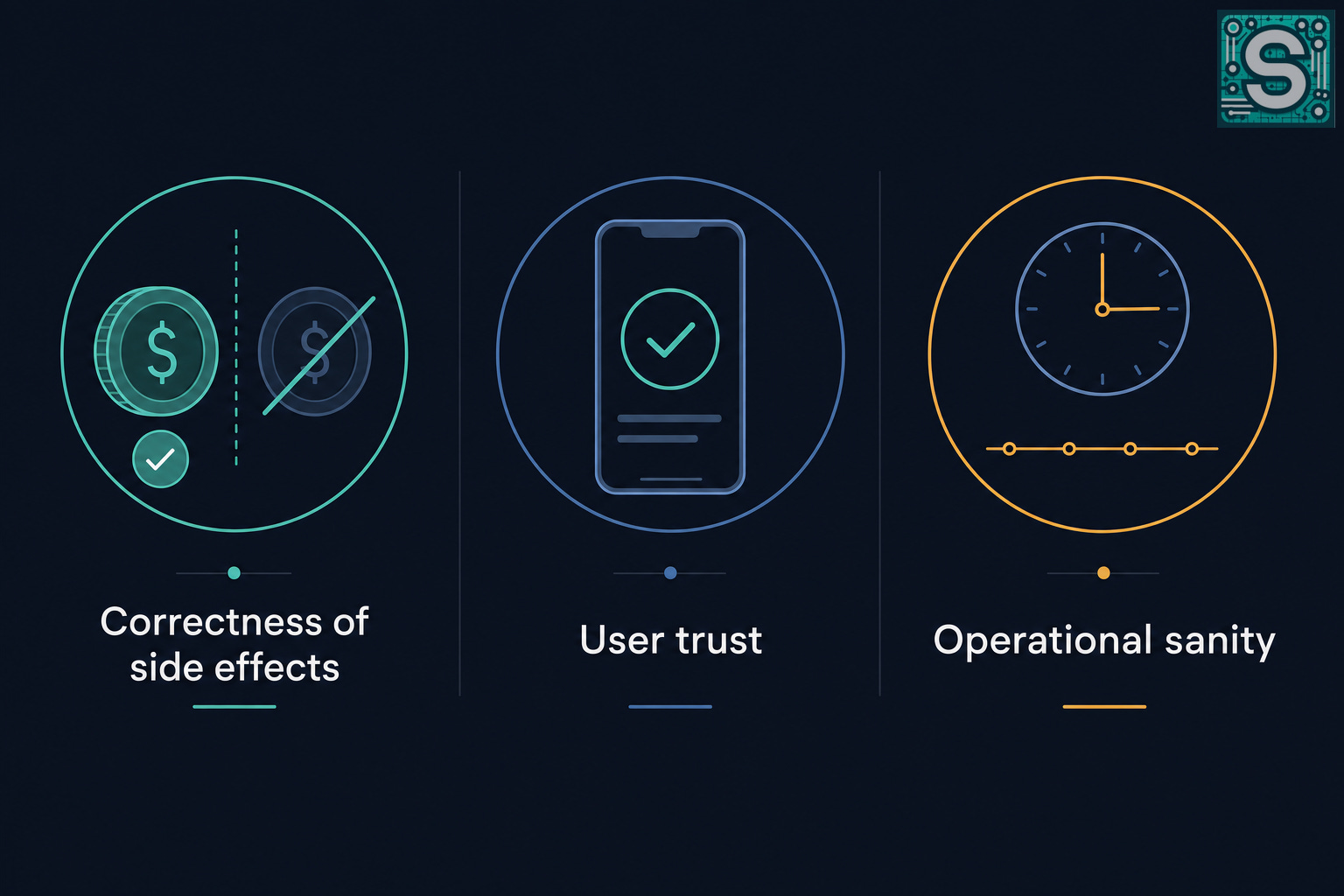
Correctness of side effects is the obvious one. Charge once. Ship once. Create one user account. Send one password reset email. Reserve one seat. The system can do lots of internal work, but the external effect - the thing that matters - should not multiply just because the network got flaky.
User trust is the quieter one. People can tolerate a spinner, even an error screen, if the outcome is consistent. What they struggle with is ambiguity: “Did it go through? Should I try again? Am I about to get charged twice?” Idempotency lets you build UX that confidently says, “Yes, you can retry. It won’t hurt”.
Operational sanity is the one you feel at 3 a.m. Without idempotency, you end up with manual reversals, reconciliation jobs, and a long backlog of “we should clean this up later” scripts. Idempotency doesn’t eliminate incidents, but it turns a whole category of chaos into something closer to routine.
There’s an important scope note that’s worth setting early because it prevents disappointment later. Idempotency is easiest when the “result” is well-defined. “Order exists with ID X” is a crisp outcome. “Charge captured with transaction ID Y” is a crisp outcome.
It gets harder when the action inherently implies repetition, like “increment counter” or “add $10 to balance”. Those are not impossible to make idempotent, but you can’t do it by waving the word “idempotent” at the problem. You have to change the shape of the operation so there is a stable outcome you can converge on.
The idempotency key in the request path
The mental model: give every attempt the same receipt number
The simplest way I’ve found to explain idempotency is to talk about a receipt number.
When a user performs one logical action - “place this order” - you want every attempt at that action to carry the same identity, the way every follow-up email in a thread carries the same context. If you don’t hear back, you can resend. But you resend the same thread, not a brand-new message with no reference.
In API terms, that “receipt number” is commonly called an idempotency key. It’s a unique token that identifies the intended operation, not the network attempt.
So “create_order” becomes: “create order for this cart, under idempotency key K”. If the phone retries, it retries with the same K. If a gateway retries, it retries with the same K. If the user double-clicks, both clicks carry the same K. All of those become different deliveries of the same logical request.
The conceptual flow
The flow is almost boring, which is part of why it works.
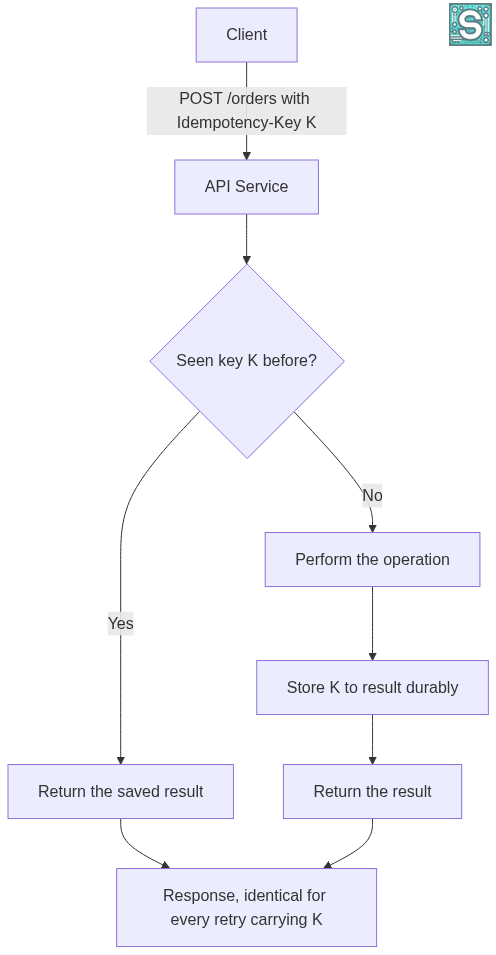
First, the client picks or receives an idempotency key. The important part is not where the key comes from; it’s that the key is stable across retries for the same action.
Then the request arrives at the server with that key.
The server checks: have we already processed this key?
If the answer is yes, the server returns the stored outcome (or at least a stable view of where the operation ended up). From the client’s perspective, this feels like “the retry succeeded”, even though the system is really saying, “You already asked; here’s what happened”.
If the answer is no, the server proceeds to do the work.
Finally, the server records the outcome tied to the key, durably, so that future duplicates can be answered consistently.
What makes this work is that it turns the network’s ambiguity into an application-level certainty. You can’t stop timeouts from happening, but you can decide what a timeout means: it means “I don’t know”, not “it failed”. And when you retry, the system can resolve that uncertainty by looking up the key.
Request-level idempotency
What to return on duplicates
This is where idempotency stops being a purely mechanical trick and becomes a product and design decision.
For some operations, the cleanest behavior is to return the same response on duplicates. If the first attempt created order 12345, every retry should return order 12345. The same body, the same identifiers, the same semantics. If you can make it identical, clients become simpler and your system becomes easier to reason about.
But sometimes the first attempt is still running when the duplicate arrives. Maybe the downstream payment processor is slow. Maybe you’re doing fraud checks. Maybe you’re waiting on inventory reservation. In that case, returning the final response isn’t possible yet. What you can return is a stable current state: “processing”, “completed”, or “failed”.
The goal, either way, is convergence. Retries should not branch reality into parallel universes. They should collapse onto one logical outcome, even if that outcome takes time to reach.
What deduplication costs you
Idempotency is one of those features that feels like a pure win until you build it. Then you realize it’s less like flipping a switch and more like adding a new organ to your system. Useful, sometimes necessary, but not free.
What idempotency improves is exactly what you want in a world of retries.
Correctness under retries gets dramatically better because duplicates no longer create duplicate effects. When things go wrong - timeouts, restarts, transient failures - you’re not compounding the problem by creating extra charges and extra orders.
Resilience improves because clients can retry aggressively without “double spending”. This matters in practice because many layers will retry whether you want them to or not. If your system is not safe under retries, you’re effectively betting your correctness on the hope that retries don’t happen. That’s a bad bet.
Operator confidence improves too, in a very human way. When incidents happen, you can focus on latency and availability without also worrying that every timeout is secretly creating a financial mess.
But idempotency makes some things worse, and it introduces new risks you have to be honest about.
The first cost is state you didn’t have before. To remember that key K was processed, you need a place to store it and a way to look it up. That means extra reads and writes on the critical path of your most important endpoints. It also means schema decisions: what exactly do you store - request hash, response body, status, timestamps, error details?
The second cost is latency. Even if the idempotency store is fast, “fast” is still time. And if you need stronger guarantees - like preventing concurrent duplicates from both executing - you may need coordination that adds more overhead. Under load, this can become a real contributor to tail latency.
The third cost is complexity, and not the pleasant kind. You now have to define what “same operation” means precisely. Is “create order” the same if the cart contents are different? Is it the same if the shipping address changed? Is it the same if the currency changed? Idempotency pushes you to draw boundaries that your product may not have made explicit before.
The fourth cost is storage growth. Keys and outcomes don’t clean themselves up. You need retention policies - time-to-live, cleanup jobs, archival, maybe even legal considerations depending on what you store. And once you introduce cleanup, you introduce another decision: what happens to late retries after the key expires?
Then there are the new risks.
Key misuse is the most common. If a client accidentally reuses a key for a different intended action, your system will “dedupe” something that shouldn’t be deduped. From the system’s perspective, it’s being consistent. From the user’s perspective, it’s doing the wrong thing while insisting it’s doing the right thing.
Poisoned outcomes are subtler. If you store a bad or partial result - say, you saved “success” before all side effects were truly safe, or you saved a response that doesn’t reflect reality - you can end up consistently repeating the wrong response. Idempotency is a memory. And memories can be incorrect.
Hot keys and contention show up during incidents. When a client times out and retries rapidly, or when a whole fleet retries at once, you can get a thundering herd focused on one key. If your protection mechanism involves locking or serialization, that single operation identity can become a bottleneck. The irony is real: the feature designed to make retries safe can become a focal point for retry traffic.
These costs force explicit trade-offs, and it’s worth naming them because they show up in design reviews and in postmortems.
There’s an availability vs correctness trade-off. If the idempotency store is down, do you fail closed - refuse to proceed because you can’t guarantee you won’t duplicate side effects - or do you proceed and accept the risk? “Fail closed” protects correctness but harms availability. “Proceed” keeps the system moving but can reintroduce duplicate effects right when the system is already degraded.
There’s a simplicity vs scalability trade-off. A single idempotency table is conceptually clean. At scale, it can become a high-traffic dependency for your hottest endpoints. You may need partitioning, caching, careful indexing, or other strategies to keep it from becoming the bottleneck that defines your throughput.
And there’s a latency vs consistency trade-off. Stronger guarantees - especially under concurrency - often require more coordination. You can make duplicates harmless in a “best effort” way with minimal overhead, or you can make them safe under more adversarial timing with stronger coordination. The more certainty you demand, the more you tend to pay.
Where retries already live
Idempotency shows up in more places than people expect, because retries show up in more places than people expect.
APIs are the obvious home. Payment and checkout endpoints are the classic examples: “charge customer”, “create order”, “confirm purchase”. These are exactly the operations where users will retry under uncertainty and where duplicate effects are expensive.
But “create user” is another one that quietly matters. Sign-up flows are full of retries: users double-submit forms, mobile networks drop, verification emails arrive late, and frontend code retries when it thinks the request failed. Without idempotency, you end up with duplicate accounts, conflicting verification states, and confusing “email already in use” errors that are technically true but emotionally wrong.
Databases offer another angle: sometimes the easiest way to make an operation idempotent is to stop treating it as “create something new” and start treating it as “ensure something exists”. If the client supplies a stable identifier, the database can enforce uniqueness. A unique constraint is, in a sense, a form of idempotency enforcement. It’s not the whole story - because you still have to decide what to do when a duplicate hits - but it’s one of the most grounded, battle-tested primitives for deduplication.
Queues and background jobs are where idempotency becomes less optional and more foundational. Many messaging systems prioritize availability and throughput and therefore lean toward at-least-once delivery. That’s a polite way of saying: sometimes you will see the same message twice. If your job handler is not idempotent, your system’s behavior becomes probabilistic. Most days it’s fine, and then one day it sends the same email twice to a million users because a consumer crashed at just the wrong moment.
Caches are a quieter case. When retries or concurrent requests trigger expensive recomputation, you can get stampedes. Idempotency-like techniques - “only one of these computations should win; others should reuse the result” - help keep the system stable under load. Even when you’re not dealing with money, you’re still dealing with duplicated work, which can be the first step toward a cascading outage.
Microservices make the need sharper because they multiply the number of retry boundaries. Service A calls service B and times out. It retries. But service B might have completed the request and simply failed to respond in time. Without idempotency, your internal calls become duplicate side effects, which then fan out. One timeout can lead to two shipments, two inventory decrements, two ledger entries - each “reasonable” in isolation, disastrous in combination.
If you’ve worked in production, you’ve probably seen the familiar behaviors that fall out of these designs. You’ve seen “Your request is being processed” responses that exist not because product wanted them, but because reality demanded them. You’ve seen duplicate email notifications that show up only during latency incidents. You’ve seen two shipments created for one order because the warehouse integration had a retry policy nobody knew about. You’ve seen the same job run twice and then watched engineers debate whether it’s a bug or “just at-least-once semantics”.
Idempotency is the practice of deciding, ahead of time, that duplicates will happen - and teaching your system to treat them as noise rather than as commands.
Half-idempotent systems and ghost orders
When idempotency is missing or partially implemented, systems tend to fail in recognizable ways. The tragedy is that these failures often appear only when the system is already under stress - during a latency spike, a deployment, a regional network issue. That’s when retries increase, concurrency gets weird, and all the assumptions you didn’t know you had start to break.
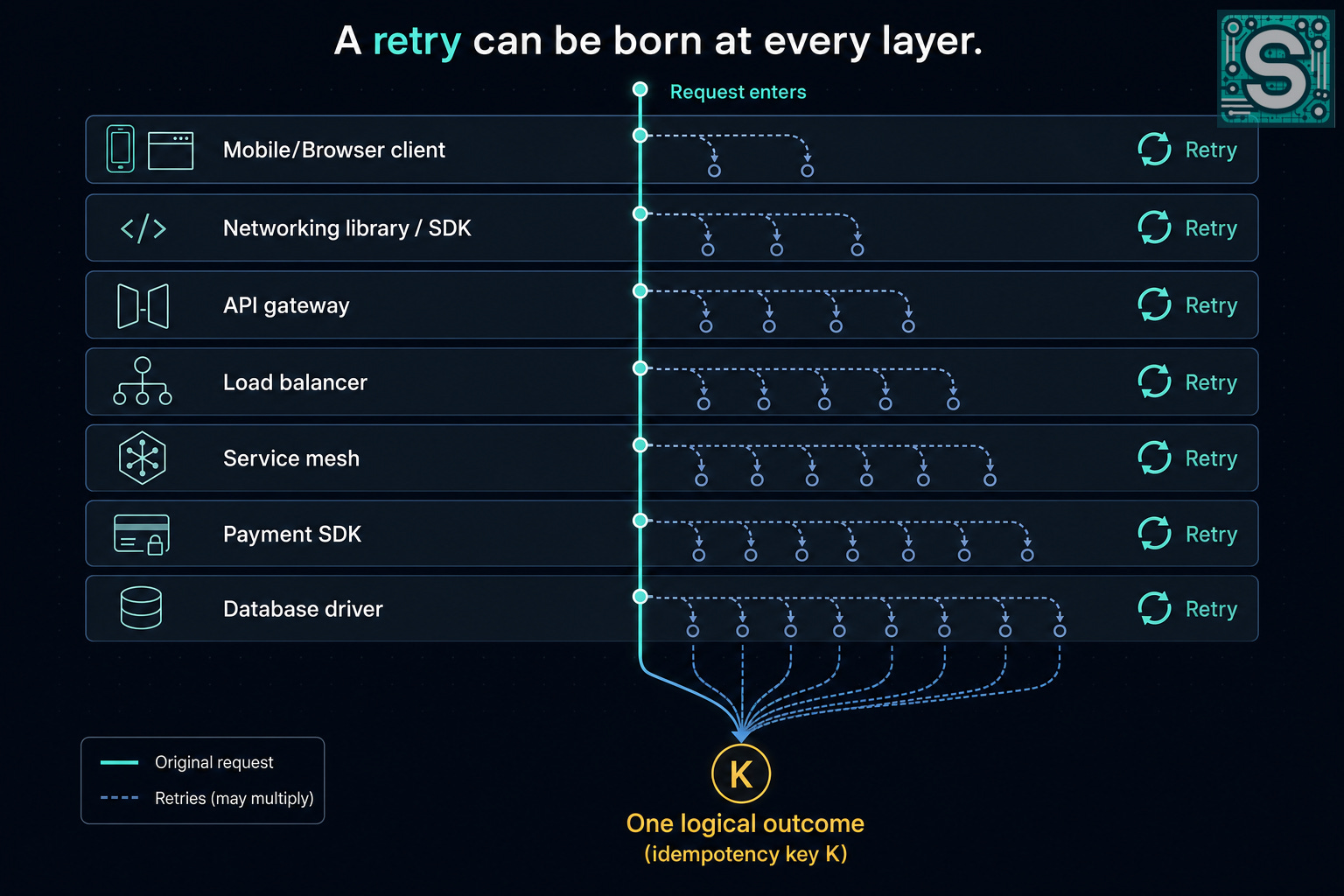
One common mistake is assuming HTTP retries are rare. In real stacks, retries happen at many layers: the browser or mobile client, the app’s networking library, the API gateway, the load balancer, the service mesh, the SDK that talks to your payment provider, even the database driver. You can build “no retries” into your application logic and still get retries. The only reliable strategy is to design endpoints so that retries are safe.
Another mistake is making only part of the operation idempotent. This is the “we deduped the order record, so we’re fine” trap. The order creation might be safe, but the confirmation email might not be. The warehouse fulfillment request might not be. The analytics event might not be. When the incident hits, you end up with one order, two emails, and two shipments - which is arguably worse than two orders, because now your own system insists it was correct while your users hold the evidence that it wasn’t.
Using idempotency only in memory is another classic. It works in a single instance during a happy-path test. Then you redeploy. Or the process restarts. Or a retry lands on a different instance. And suddenly the “dedupe” mechanism evaporates right when you need it most. In distributed systems, if you want something to survive, it has to live somewhere more durable than a single process.
There’s also a conceptual mistake: confusing idempotency with “no duplicates ever”. In practice, duplicates can still happen. You might still process the same message twice internally. You might still write two rows if you have a bug. Idempotency is not a magic spell that prevents duplication. It’s the discipline of making duplicates harmless - making the outcome stable even when the world gets messy.
Finally, many teams forget to define the idempotency window. If you expire keys too soon, late retries can re-trigger side effects. And “late” is a slippery concept. Mobile clients can retry minutes later. Background jobs can be delayed. Users can hit refresh hours later if the UI is confusing. If your key TTL is shorter than the time it takes for retries to plausibly occur, you’ve built a correctness feature that disappears on a timer.
When these mistakes surface, the symptoms are painfully consistent.
Users see double charges, multiple orders, duplicate notifications. They see confusing “error” screens followed by “success” later, which is the worst kind of UX because it teaches them to distrust both the error and the success.
Operators see reconciliation scripts and manual refunds. They see “ghost orders”, where payment succeeded but order creation retried into a new ID, leaving finance and fulfillment disagreeing about what is real. They see support ticket spikes after latency incidents, because latency incidents are also retry incidents, and retry incidents are correctness incidents if you haven’t made retries safe.
The hardest part is that these failures often don’t show up in unit tests. They show up in the spaces between components: in timeouts, in restarts, in packets that arrive late, in requests that get duplicated by a proxy you forgot existed. Which is why idempotency is less about cleverness and more about humility.
A timeout is missing information
Idempotency exists because of a philosophical truth that distributed systems force you to confront: you don’t get certainty for free.
A timeout is not a fact. It’s missing information.
When a client times out, it hasn’t learned “the server failed”. It has learned “I did not receive a response within my patience window”. The server might be down, or it might be slow, or it might have succeeded instantly and lost the reply. The timeout tells you something about your observation, not about reality.
Once you internalize that, a lot of system design starts to look different. You stop building flows that require the network to be honest and instantaneous. You stop treating retries as exceptional. You start treating repetition as a normal conversational pattern between components that don’t fully trust each other.
Idempotency is one of the clearest expressions of that habit: design actions so that repeating yourself is safe.
The human analogy is surprisingly close to how the best systems behave. If you send an important email and you don’t hear back, you might reply to the same thread: “Following up on request #123”. That reference number is doing the same job as an idempotency key. It lets the recipient say, “Yes, I saw this; here’s where it is”, instead of treating every follow-up as a brand-new request that triggers a brand-new action.
Without a reference, every resend looks like a new request. And people respond the same way systems do: they get confused, they duplicate work, and eventually someone gets annoyed and starts asking why there are three identical tasks in the queue.
There’s also an organizational angle that’s easy to underestimate. Idempotency reduces the need for hero debugging and manual cleanup. It turns failure handling from panic into procedure. When you know retries won’t corrupt the world, you can be more aggressive about retrying, more confident during incidents, and more disciplined about automation. You’re not relying on perfect behavior; you’re relying on safe behavior under imperfection.
And that’s a broad system design lesson worth keeping: the goal is not to eliminate uncertainty. The goal is to build systems that remain correct even when uncertainty is present.
💬 Where has a lost response or a silent retry burned you — and how did you make it safe? I read every reply.
Designing for safe repetition
Idempotency exists because timeouts and retries are unavoidable, and they blur the line between “did it happen?” and “did I hear about it?” In a distributed system, that ambiguity is not a corner case. It’s a daily condition, especially once you involve mobile networks, multiple services, and any kind of external dependency.
The goal of idempotency is simple to say but surprisingly deep in practice: retries should converge to one logical outcome, not multiply side effects. You want the system to behave as if the user acted once, even if the network delivered that action multiple times.
Most implementations follow the same conceptual shape. You give each logical operation a stable identity - an idempotency key - and you remember the outcome durably. When duplicates arrive, you don’t re-run the side effects; you return the previously recorded result (or a stable status if it’s still in flight). This turns the retry button from a source of bugs into a feature: a safe way to recover from missing information.
But idempotency isn’t free. It adds state, latency, and real design complexity. You have to define what “same operation” means, you have to decide what to return on duplicates, you have to manage retention windows, and you have to think through failure modes of the idempotency mechanism itself.
And the hardest part is rarely the mechanism. The hardest part is deciding which side effects must be deduped and how far the guarantee should extend. It’s one thing to dedupe “create order”. It’s another to ensure that “charge”, “email”, “shipment”, and “ledger entry” all converge on the same logical truth under retries, concurrency, and partial failure.
When teams get this wrong, the failures are predictable: double charges, duplicate messages, conflicting records, and messy reconciliation after incidents - exactly when the system is already stressed. When teams get it right, the system doesn’t become perfect. It becomes calmer. It becomes the kind of system where uncertainty is expected, repetition is safe, and correctness doesn’t depend on the network behaving nicely.
In the end, idempotency is less a feature you tack on and more a mindset you adopt. Once you start seeing timeouts as missing information and retries as normal conversation, you begin designing systems that can tolerate the world as it is: slow, flaky, concurrent, and occasionally unfair. That design habit - building for safe repetition - pays dividends far beyond payments, because it’s really a way of making distributed systems honest with themselves.
📬 This is the opening piece of System Design Fundamentals — one clear primitive at a time, no hype. Subscribe and the next one lands in your inbox.
References
Idempotent requests | Stripe API Reference
Designing robust and predictable APIs with idempotency by Brandur Leach | Stripe Blog
RFC 9110: HTTP Semantics | IETF
Time, Clocks, and the Ordering of Events in a Distributed System by Leslie Lamport | Communications of the ACM
Life Beyond Distributed Transactions: An Apostate's Opinion by Pat Helland | ACM Queue
Designing Data-Intensive Applications by Martin Kleppmann | O'Reilly
Transaction Processing: Concepts and Techniques by Jim Gray & Andreas Reuter | Morgan Kaufmann
Release It! by Michael Nygard | Pragmatic Bookshelf