
Backpressure — when saying "slow down" saves the system
System Design Fundamentals


Picture a flash sale.
Not a steady “more traffic than usual”. A step-function.
One minute the site is busy-but-fine. The next minute, traffic is unreasonable. Social posts land, push notifications fire, and suddenly your checkout flow is getting hit like it’s the only doorway out of a stadium.
And what’s unsettling is that it doesn’t fully go down.
It gets weird.
Pages still load. Browsing still works. Product detail pages are mostly okay. But checkout turns into a haunted house:
the “Place order” button spins and spins
some users time out quickly, others succeed after 30 - 60 seconds
support starts reporting duplicates: “I clicked twice because it froze”
your payment provider dashboard looks normal-ish, but your database graphs look… sticky
Then the on-call engineer notices something that feels wrong.
CPU isn’t pegged everywhere. Some app pods are cruising at 30 - 40%. Autoscaling has helped a bit. Nothing is obviously “on fire” at the compute layer.
But one downstream dependency - maybe the database, maybe inventory, maybe payments - has gotten slower than usual. Not dead. Just slower.
And in the metrics you can see the shape of the disaster forming:
queue depth climbing steadily
in-flight requests rising and never coming down
timeouts starting to pepper the logs
thread pools slowly filling like a bathtub with a clogged drain
That’s the scary part: a small slowdown starts behaving like an outage.
Not because the system is “down”. Because it’s panicking.
You can feel it in the symptoms: the system is spending more and more energy waiting. And waiting is not free.
We’ll name what’s happening soon. For now, just sit with the lived experience:
A checkout system that’s “mostly up” can still become unusable. And it can happen fast.
🚦 If you've watched a small slowdown snowball into a self-inflicted outage, this is the mechanism — send it to whoever owns the checkout path.
When work outpaces capacity
What breaks at scale
Work arrives faster than it can be completed. This is the most basic mismatch in systems. If a downstream can handle 500 req/s but receives 1,000 req/s, the extra 500 doesn’t disappear.
It waits somewhere.
And it’s tempting to think waiting is harmless. After all, queues exist. Buffers exist. “We’ll just let it pile up for a bit.”
But that brings us to the second point.
Waiting consumes real resources. Each “waiting” request is not just a line in a log. It’s usually holding onto something:
memory for request/response objects
sockets and file descriptors
threads or async tasks
entries in a queue
locks, transactions, or connection pool slots
CPU cycles doing retries, timeouts, and bookkeeping
So the cost of “we’ll just wait” is that you’re slowly converting a capacity mismatch into resource exhaustion.
And then there’s the reality that makes this worse than most people expect:
Partial failure is common. Dependencies often don’t crash cleanly. They degrade.
a DB replica is overloaded and starts responding in 800ms instead of 30ms
a third-party API starts tailing at 5 - 10 seconds
a hot shard gets noisy neighbors
a cache cluster is fine, but a small percentage of keys now miss and trigger expensive recomputation
This kind of slowdown is the most dangerous failure mode because it’s ambiguous. It still “works”, but it works slowly enough to poison everything upstream.
Why naive solutions stop working
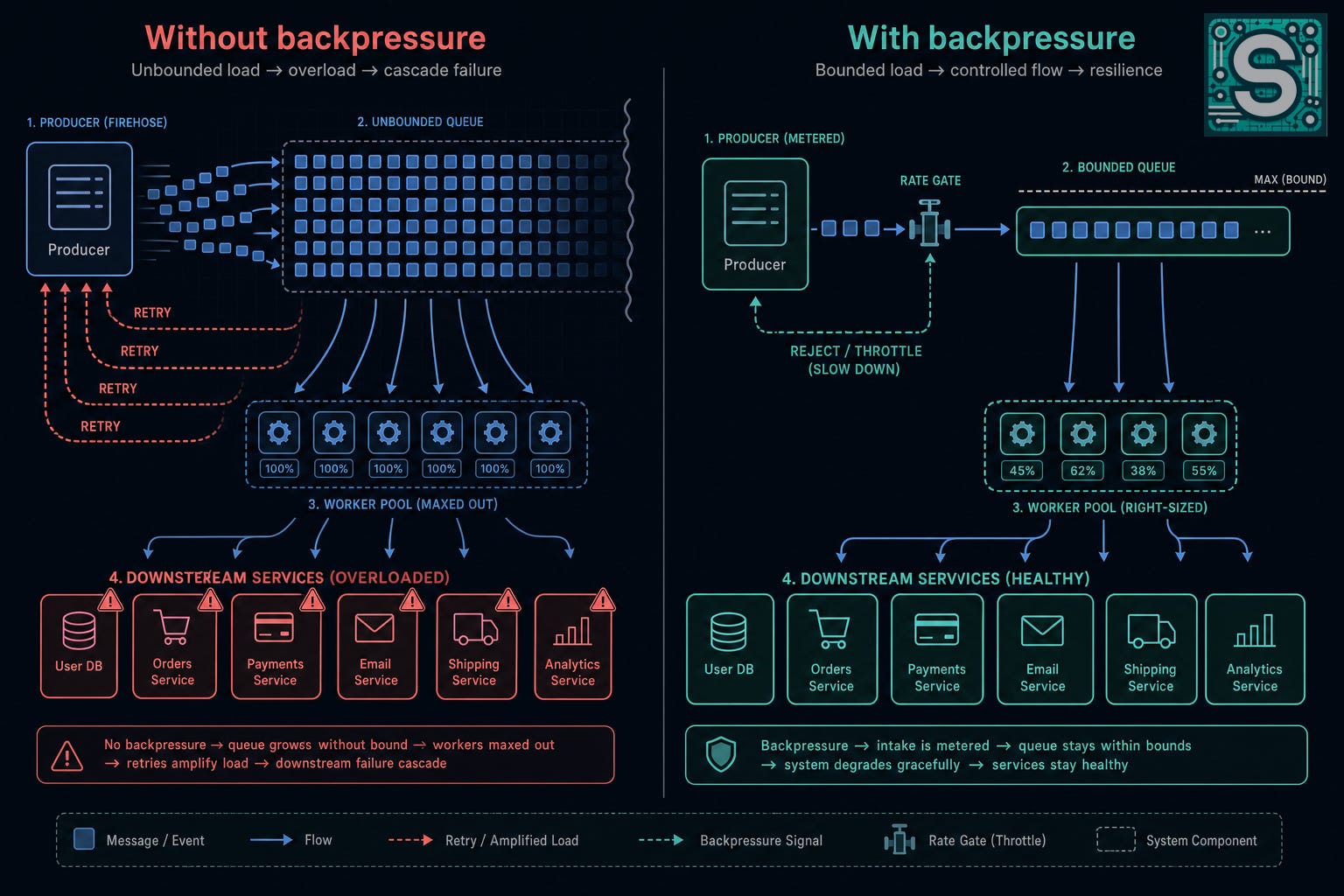
Unbounded buffering turns overload into latency (and then into outages). If you accept requests into an unbounded queue (or a queue that is “effectively unbounded”), you’re choosing a particular failure shape:
you hide overload for a while
latency grows gradually
timeouts start to appear far from the root cause
recovery becomes painful because you now have a backlog to drain
Large buffers are polite. They let everyone in the door.
But politeness during overload is often just delayed failure. And delayed failure tends to be bigger.
Retries multiply traffic during the worst moment. Timeouts cause clients to retry. Services retry each other. SDKs retry silently. Load balancers retry idempotent calls. Humans retry by clicking the button again.
Now your bottleneck - the one thing that is already slow - gets hit with more traffic.
This is how a system DDoSes itself without any malicious actor. It’s just a collection of “helpful” components doing what they were told: “try again if it fails”.
More concurrency can reduce throughput. This is deeply unintuitive when you’re early in your systems journey. It feels like:
“If we have a backlog, we should process more in parallel.”
But shared bottlenecks don’t behave that way.
DB locks become contended
connection pools run out
caches thrash
CPU spends more time context switching
tail latencies inflate, which increases in-flight work upstream
eventually effective throughput drops even though you’re “doing more”
A good mental model is a busy intersection. Adding more cars doesn’t increase throughput once you’ve reached saturation. It creates gridlock.
Distributed systems realities
This whole situation is the consequence of a few boring truths that become dramatic at scale:
Latency: when a downstream gets slower, upstream holds onto more in-flight work.
Concurrency: many callers amplify contention and queue growth.
Independent components: each service “does its job” unless forced to coordinate.
Uncertainty: you can’t reliably tell “slow” from “dead” in the moment.
And because you can’t tell “slow” from “dead”, systems often behave optimistically. They keep sending work, hoping the slowdown is temporary.
Hope is not a strategy. In distributed systems, hope is often how outages start.
Pushing "slow down" upstream
Backpressure is a feedback mechanism that pushes “slow down” upstream so the system stays within safe operating limits.
Notice what that implies: we’re not talking about a single feature. Backpressure is a relationship between parts of a system. A way for a constrained component to say:
“I’m falling behind. If you keep pushing at this rate, we’ll both go down.”
Backpressure tends to optimize for a few pragmatic goals:
stability over politeness
It’s better to refuse some work than to stall everything.
boundedness
Finite queues. Finite in-flight requests. Finite memory growth. The system should have hard edges.
recoverability
Avoid digging a hole you can’t climb out of. If you build a two-hour backlog, you might survive the spike but still lose the incident because you can’t drain fast enough.
A stadium with one exit
Think about a stadium with a single narrow exit.
If you let everyone rush that door at once, you get crushing gridlock. People push, movement slows, panic rises, and eventually nobody moves.
So what do cities (and event staff) do?
They meter the flow. Barriers. Lines. Temporary gates. A controlled release of people.
It’s annoying in the moment. But it prevents a worse outcome.
Backpressure is that metering. It’s the system admitting: “We have one door here. We can’t pretend we have ten.”
From pressure to a stable rate
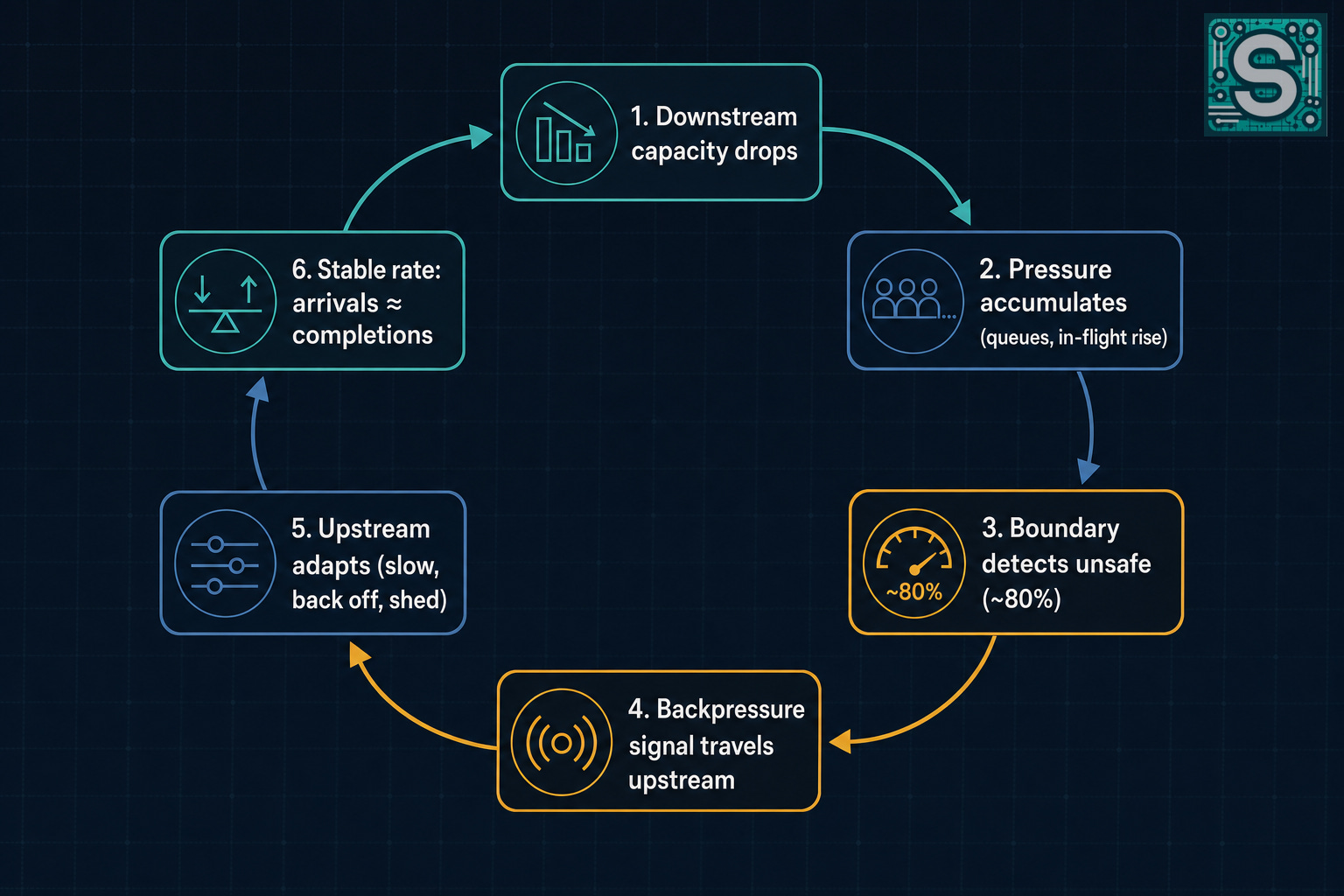
The basic loop: pressure → signal → adaptation
Let’s walk through the loop as it happens in real incidents. Not the clean textbook version - the slightly messy one you see on dashboards.
Downstream capacity drops
Maybe the DB is slow because of a long-running query. Maybe a payment provider is tailing. Maybe a hot partition is melting. The exact reason doesn’t matter. What matters is: completions per second go down.
Pressure accumulates
Upstream continues sending at the old rate. Now you have mismatch. Pressure shows up as:
rising queue length
rising in-flight request count
higher connection pool usage
rising latency
more time spent waiting on locks or IO
A boundary detects unsafe conditions
This is important: backpressure is usually triggered before “100% broken”.
It’s “we’re approaching unsafe”.
queue at 80% of capacity
worker pool saturated
error rate rising
p95/p99 crossing a threshold
connection pool nearly exhausted
Backpressure signal travels upstream
The system communicates “slow down” by:
rejecting requests (fast failure)
throttling (rate limiting)
blocking (making callers wait)
degrading (serving a simpler response)
Different systems choose different signals, but they all communicate the same thing: do less work right now.
Upstream adapts
Good upstream behavior looks like:
reduce send rate
back off (increasing delays between attempts)
prioritize higher-value work
shed load (drop optional work)
System reaches a stable rate
Arrivals ≈ completions.
Not because the world got nicer, but because the system stopped pretending it had infinite capacity.
This is the quiet win of backpressure: you trade a chaotic meltdown for controlled degradation.
Where backpressure is applied
Backpressure isn’t one location. It’s a design choice about where you want to enforce limits.
Admission control at entry points
“We’re at capacity; we won’t accept more right now.”
This is the most user-visible form: 429s, “Try again”, “We’re experiencing high demand”.
Bounded queues between stages
“The waiting room is full; stop sending people into the hallway.”
Queues are useful when they are bounded. They absorb short bursts and smooth jitter. But they need to have a maximum, otherwise they become a slow-motion memory leak.
Concurrency limits at dependency boundaries
“Only N requests may call this dependency at once.”
This is a strong pattern because it protects the fragile parts: DB pools, third-party APIs, expensive computations. It prevents one slow dependency from consuming the entire service’s attention.
The forms a “slow down” signal takes
Once you’ve decided where to enforce a limit, there’s still the question of how the “slow down” is expressed. A few forms recur across real designs.
A bounded queue with blocking makes producers wait when the queue is full. It’s straightforward and effective inside a single process, where blocking is cheap and well understood; it turns overload into waiting rather than memory growth.
A bounded queue with rejection hands producers an immediate “try later”. It can feel harsh, but it has a virtue: it’s honest. It stops the system from accepting promises it can’t keep.
Pull-based consumption flips the default: consumers request work only when they’re ready, instead of having work pushed at them. In push systems you have to add backpressure; in pull systems it’s more natural, because the consumer controls the rate.
Credits or tokens let a producer send a fixed number of items and send more only when credits are returned. It’s a clear accounting system for in-flight work - like giving customers numbered tickets, where only ticket holders may enter.
And windowing keeps only a limited number of in-flight items at once. It shows up in networking and streaming, anywhere “too much concurrency” is the real problem: the window caps parallelism even when the producer could send more.
All of these share one idea: make the rate of production reflect the reality of consumption.
The flow in one picture

This diagram is simple, but the behavior it creates is profound:
Instead of letting pressure silently pile up, you force it to become visible as early as possible, where it can be managed.
What saying no costs you
What backpressure improves
Prevents cascading failure. Cascades happen when a slowdown in one place creates overload elsewhere.
Without backpressure, an upstream service continues to accept work it can’t finish. It accumulates in-flight requests, saturates pools, increases latency, triggers retries, and now multiple services become unhealthy.
Backpressure breaks that chain. It says: “This damage stops here”.
Protects critical resources. Some resources are “hard to recover” once exhausted:
thread pools that get stuck waiting
memory growth that triggers GC storms or OOM kills
connection pools that deadlock under contention
file descriptor exhaustion
queues so large they can’t drain in reasonable time
Backpressure keeps these resources from being consumed by work that has no chance of completing promptly.
Improves tail behavior. Users don’t experience your averages. They experience your tails.
Backpressure tends to reduce “infinite wait” behavior. It draws sharper lines:
either you get a result quickly
or you fail quickly and try later
This is emotionally painful (nobody likes errors), but operationally healthy. A system that fails fast under overload is often more trustworthy than a system that randomly hangs.
What it makes worse
Some requests fail sooner. This is the whole point, and it’s worth stating plainly.
You are replacing “hang forever” with “try again”.
That means you’ll see more errors during spikes. But those errors are controlled and often temporary. The alternative is a slow death spiral where everyone gets a bad experience.
Perceived availability may drop during spikes. If you measure availability as “percentage of successful requests”, backpressure can look like a regression during overload.
But if you measure availability as “can real users complete critical actions”, backpressure usually improves outcomes.
A checkout system that rejects 20% quickly but lets 80% succeed reliably is often better than one that accepts 100% and lets 60% time out after a minute.
New risks it introduces
Over-throttling. If your thresholds are too conservative, you leave capacity unused and create errors you didn’t need.
This can happen when:
limits are static but traffic patterns change
you don’t differentiate endpoints (cheap vs expensive)
your signals lag reality (you throttle based on old data)
Unfairness. One tenant can crowd out others unless you isolate budgets.
If backpressure is global, the loudest customer wins. That’s the “noisy neighbor” problem. And it becomes a business problem fast.
Oscillation / jitter. Feedback loops can overcorrect:
throttle too hard → pressure drops → remove throttle → pressure spikes → throttle again
This produces a sawtooth pattern: alternating between “too strict” and “too loose”. Users experience it as randomness.
The trade-offs you can't escape
These trade-offs show up in postmortems again and again. Naming them early helps you make peace with them.
Availability vs correctness: rejecting work preserves system health but drops/defers operations.
Latency vs consistency: quick failures can surface temporary inconsistency to users (e.g., “order status unknown, try again”).
Simplicity vs scalability: “accept everything” is simple; “accept safely” scales.
Throughput vs tail latency: chasing throughput with unbounded queues destroys p99 and recovery time.
Backpressure is a decision to be disciplined about limits.
It’s less “can we handle it?” and more “what do we do when we can’t?”
Backpressure you already have
Backpressure is one of those concepts that sounds abstract until you recognize it hiding in plain sight. Many production systems already have backpressure - sometimes accidentally.
APIs
rate limits, concurrency caps, “busy/try later” responses
These are explicit backpressure. The system is telling clients: “I can’t take this right now”.
prioritization (checkout > recommendations)
Under overload, it’s common to keep the core path alive by shedding optional work. If recommendations fail, users are mildly annoyed. If checkout fails, you lose revenue and trust.
This is backpressure as product policy.
Microservices
per-dependency in-flight limits
A service might be healthy overall, but one downstream is slow. If you don’t cap calls to that downstream, it can consume all threads/tasks and make the whole service look dead.
Per-dependency limits say: “This dependency gets at most N concurrent requests. The rest of the service can still function”.
budgets per tenant/customer (noisy neighbor control)
A single customer running a batch job shouldn’t melt the experience for everyone else. You enforce fairness by giving each tenant a slice of capacity.
This is backpressure as multi-tenant governance.
Queues / pipelines
bounded buffers between stages
Pipelines are classic backpressure terrain: producers and consumers run at different speeds. Bounded buffers allow short bursts, but force coordination when the mismatch becomes sustained.
producers slow down when consumer lag grows
This is the ideal: lag is a signal, not something to hide. If consumer lag grows, producers should slow or drop lower-priority messages.
This is backpressure as pipeline stability.
Databases
connection pools as “natural” backpressure
A connection pool is a limit: once exhausted, callers must wait or fail.
That’s backpressure - whether you intended it or not.
The danger is when you rely on it as your only backpressure. If every request blocks waiting for a DB connection, you can exhaust threads and memory upstream.
query concurrency limits to avoid lock thrash
Databases often degrade under too much concurrency. Limiting concurrency can increase throughput by reducing contention.
This is backpressure as contention management.
Caches
limiting concurrent cache-miss refills to protect the origin
If a hot key expires and thousands of requests miss at once, they can stampede the origin (DB or service). A cache that limits concurrent refills is applying backpressure to the refill path.
coalescing duplicate requests so 1 refill serves many waiters
Instead of letting 1,000 identical misses trigger 1,000 origin calls, you let one request do the work and others wait for the result.
This is backpressure as anti-stampede discipline.
Unbounded queues and retry storms
Backpressure done well makes incidents smaller. Backpressure done poorly can make systems feel unpredictable - or worse, can hide problems until they’re catastrophic.
Typical mistakes
Unbounded queues. “We never drop” sounds noble.
In practice it becomes:
memory growth
long GC pauses
timeouts everywhere
crash loops
a backlog so large that even after traffic drops, you’re still in incident mode
Unbounded queues are like letting cars pile onto a bridge during a traffic jam. You’re not solving congestion. You’re moving it somewhere harder to manage.
Retry storms. Retries without budgets/backoff amplify load.
A common failure pattern:
downstream slows
upstream times out
upstream retries immediately
downstream gets more work, slows more
timeouts increase
retry volume explodes
The tragedy is that every component thinks it’s being resilient. Collectively, they’re making the bottleneck drown.
Backpressure only at the edge. You add a rate limit at the API gateway and call it a day.
But internal services still overload each other. You’ve just moved the chaos inward. Some internal service becomes the new “queue”, and it may be far less equipped to handle it.
Good backpressure is usually layered: edge + service boundaries + dependency boundaries.
No prioritization. If low-value work competes equally with critical work, overload becomes morally wrong.
Examples:
sending emails competes with checkout
analytics events compete with inventory reservations
recommendations compete with payment authorization
Under pressure, systems should have opinions about what matters.
Late signals. Throttling triggers after exhaustion, when recovery is hardest.
If you only start rejecting once thread pools are full and the DB pool is deadlocked, you’re already in the hole.
Backpressure works best when it triggers while you still have enough headroom to serve some traffic reliably.
User/operator symptoms
These are the patterns that show up in alerts and support tickets:
rising p99 latency + “random” timeouts
“it got worse when we scaled up”
queue depth rises and never returns
long recovery: incident lasts 10 minutes, draining takes 2 hours
That last one is worth lingering on.
The spike might be brief. But your backlog is a time debt.
If you let the system accumulate too much debt, you’ll pay it back slowly, painfully, and while users are still watching.
A reliable system knows its limits
A reliable system is not one that tries to do everything; it’s one that knows its limits.
That’s not defeatism. It’s engineering maturity.
Backpressure is “coordination without central control”:
you can’t perfectly synchronize components
you can’t make networks reliable
you can’t make slow dependencies instantly reveal themselves
you can’t avoid bursts and surprises
So instead, you build feedback.
You let pressure become a signal. You let constraints propagate upstream. You force the system to behave like a set of cooperating parts, not a set of independent optimists.
There’s also an organizational analogy that feels almost too real:
Teams that say “yes” to everything become unpredictable. Deadlines slip, quality drops, and priorities blur. The team looks “available”, but delivery becomes random.
Teams with clear intake limits - explicit WIP limits, explicit prioritization- feel less accommodating in the short term.
But they become trustworthy.
Backpressure is that kind of trustworthiness, expressed in infrastructure.
📬 This is System Design Fundamentals — one primitive at a time, no hype. Subscribe and the next one lands in your inbox.
Boundedness plus feedback
Backpressure aligns incoming work with the capacity that actually exists to process it. Without that alignment, overload doesn’t announce itself - it accumulates as growing queues, exhausted pools, and cascades that spread from one slow dependency to everything upstream. Buffers feel like the answer, but they aren’t free: a large queue trades immediate, honest failure for delayed and amplified failure, and the retries and extra concurrency that pile on during a slowdown usually make the bottleneck worse, not better.
What good backpressure buys you is controlled degradation instead of collapse. By throttling, rejecting, shedding, and prioritizing, the system trades a chaotic meltdown for a predictable one - and that trade has a real cost, because it means fewer successes now to prevent total collapse later. The lesson underneath all of it is that stability comes from boundedness plus feedback, not optimism.
Backpressure isn’t about being harsh. It’s about being honest.
Systems that survive load aren’t the ones that accept everything. They’re the ones that can say, clearly and early:
“Not right now. Try again soon.”
💬 What’s the worst self-inflicted overload you’ve seen — retry storm, unbounded queue, missing limit? Tell me what finally stabilized it.
References
Reactive Streams Specification | Reactive Streams
The Tail at Scale by Jeffrey Dean & Luiz André Barroso | Communications of the ACM
AWS Architecture Blog | AWS
Google Cloud Architecture Framework: Reliability | Google Cloud
Site Reliability Engineering by Betsy Beyer et al. | Google (free online)
Designing Data-Intensive Applications by Martin Kleppmann | O'Reilly
Release It! by Michael Nygard | Pragmatic Bookshelf
The Practice of Cloud System Administration by Thomas Limoncelli, Strata Chalup & Christina Hogan | Addison-Wesley